Helical Gearbox Price in India: What Changes the Final Cost?

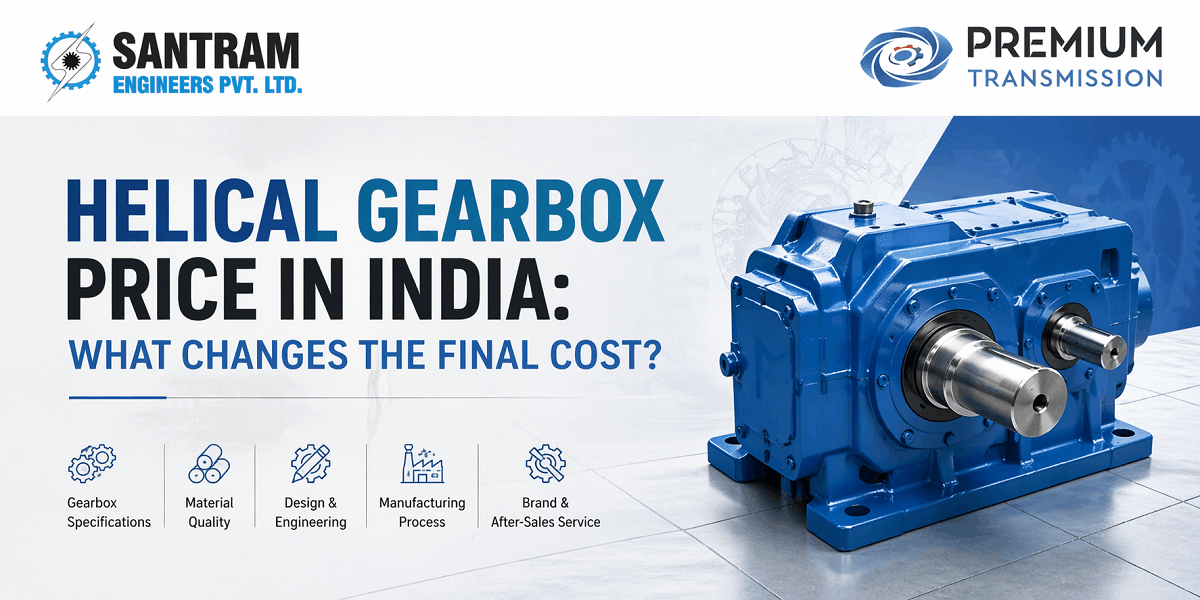
There is no single fixed price for a helical gearbox in India. Basic catalogue or small inline units can start in the low thousands, while mid-range industrial models move into the tens of thousands, and heavy-duty or application-built units can climb into the lakh range depending on torque, ratio, stages, mounting style, and customisation.
That is why two products with the same generic name can be priced very differently. This blog explains the real cost drivers in simple terms so buyers can compare quotes properly and avoid choosing on price alone.
What Usually Affects the Price of a Helical Gearbox?
Before getting into details, here is the short answer. The final price of a helical gearbox usually changes based on:
- Output torque requirement
- Gear ratio and required output speed
- Number of stages
- Mounting style
- Shaft configuration
- Housing material and build quality
- Optional features and special protection
- Whether the quote is for a standard unit or a customised industrial package
Manufacturers do not sell one universal configuration. Product families are offered across wide torque and ratio ranges, with multiple stage counts, mounting formats, shaft types, and optional protections, which is why prices vary so much across the Indian market.
Key Factors That Change the Final Cost
1. Output Torque and Load Requirement
The biggest cost driver is usually torque. When the application needs a higher output torque, the helical gearbox generally needs a larger casing, stronger gears, and bearings that can safely handle the load over time. That increases material, machining, and overall build cost.
In buying terms, a gearbox for a small conveyor and one for a crusher, mixer, extruder, or heavy process line may share the same family name but not the same price logic. Manufacturers show torque ranges that stretch from compact units to very large industrial capacities, which is why “average price” is a weak buying metric unless the duty is known first.
2. Gear Ratio and Output Speed
The required ratio also changes the cost of a helical gearbox. If a buyer needs a specific output RPM, the selected ratio may require a different gearbox size, a different stage combination, or a more exact configuration match with the motor.
This matters because price is not only about how much load the unit carries, but also about how the speed reduction is achieved. Broader catalogues show very wide ratio windows, and not every ratio sits at the same cost point. A standard ratio is often easier to source than a more specialised reduction requirement.
3. Number of Stages
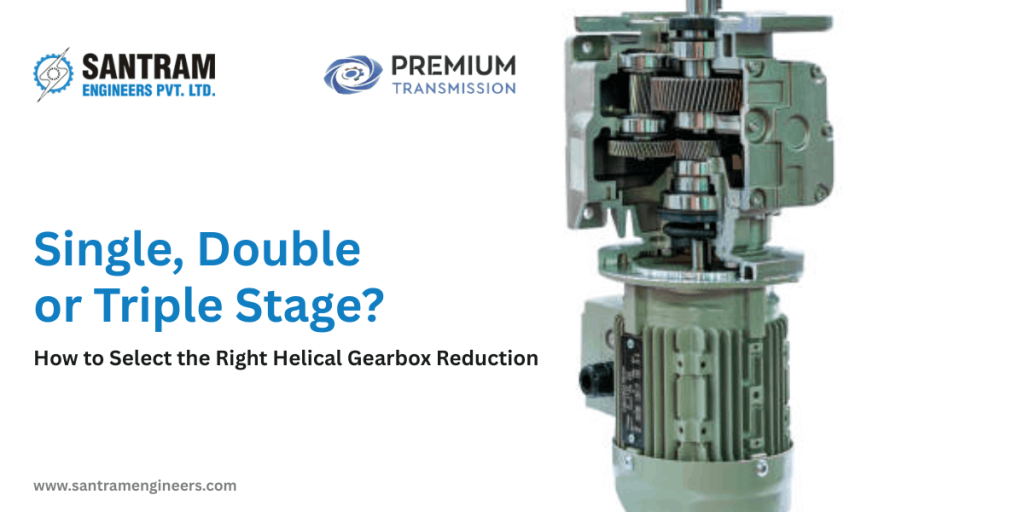
Single-stage, two-stage, three-stage, and four-stage units are not priced the same. More stages are usually used when the application needs a higher reduction, and each extra stage changes the internal build, component count, and size of the gearbox.
Some manufacturers may list helical configurations from single stage to four stages, while others may highlight inline helical range 2-, 3-, and 4-stage versions to reach wider ratio coverage. So, when one quote is based on a compact standard reduction and another on a multi-stage industrial design, the cost gap is expected.
4. Shaft Type and Mounting Style
The shaft arrangement and mounting style can also affect the price of a helical gearbox. Common decisions include solid shaft vs hollow shaft, keyed hollow shaft vs shrink-disc style, and foot-mounted vs flange-mounted construction. These are not cosmetic differences. They affect fitment, load transfer, and what kind of coupling or mounting support is needed.
Some manufacturers show how gear unit families are offered in foot, flange, shaft-mounted, solid-shaft, and hollow-shaft variants rather than one fixed format. So, a standard foot-mounted solid-shaft unit and a flange-mounted hollow-shaft version should not be expected to quote the same way.
5. Housing Material and Overall Build Quality
A helical gearbox built for light-duty catalogue use is not the same as one selected for continuous industrial service. Housing material, wall thickness, gear finishing quality, shaft strength, bearing support, and sealing quality all influence both service life and price. Smaller and lighter-duty units may use lighter housing constructions, while sturdier industrial models are typically built for higher loads, tougher environments, and longer operating cycles.
This is why the cheapest quote is not always the most economical one. In continuous service, dusty plants, corrosive areas, or shock-loaded machinery, build quality usually matters more than the headline price.
6. Optional Features and Customisation
The price of a helical gearbox rises when the application needs more than a basic standard unit. Common add-ons include reinforced bearings, special or double oil seals, fluoro-elastomer seals, reduced backlash, backstop, surface protection up to C5, corrosion-resistant components, and ATEX-ready or explosion-protected configurations. These features are typically required for more demanding operating conditions such as higher overhung loads, corrosive environments, frequent washdown, reverse-rotation protection, precision movement, or hazardous-area use. The more specialized the requirement, the more the final gearbox cost is likely to increase.
7. Supplier Scope and Delivery Terms
The quote is not always limited to the bare helical gearbox body. Depending on the supplier, pricing may also include motor coupling, mounting accessories, inspection certificates, testing, configuration work, and technical documentation. As a result, the quoted value may reflect a broader supply scope than just the gearbox alone.
That is why comparing only the total number on a quotation can be misleading. One supplier may be quoting a standard stocked unit, while another may be offering a more complete industrial package with added technical scope, documentation, and support. This becomes even more important when buyers are comparing industrial gearboxes suppliers rather than just comparing part numbers.
Indicative Helical Gearbox Price Brackets in India
| Category | Indicative Market Range in India |
What it Usually Represents |
| Small standard units | ₹4,000 to ₹15,000 | Smaller inline or basic reduction units for lighter-duty or standard applications |
| Mid-range industrial units | ₹15,000 to ₹50,000+ | Higher power, stronger build, more demanding mounting or duty requirements |
| Heavy-duty/customised units | ₹55,000 to ₹3.5 lakh+ | Larger industrial, application-specific, heavy-duty, or specialised gearbox builds |
Note: No serious industrial buyer should rely on a fixed public “price list” without checking specifications. Still, indicative market listings help show how wide the spread can be. These are indicative market ranges, not fixed selling prices. Trade listings and product pages currently show small inline units around ₹4,000 to ₹12,100, some comparison pages around ₹5.85K to ₹36.35K, and heavier-duty or larger examples from roughly ₹55,000 up to ₹95,000 or even ₹3.5 lakh for specialised helical gearbox listings. Actual quotation always depends on complete specifications.
Small Standard Units
A smaller helical gearbox often sits at the lower end of the market when the application is straightforward, the ratio is standard, and no heavy-duty options are involved. This is where many online listings create the impression that all gearboxes are inexpensive, but those prices usually refer to compact or standard configurations only.
Mid-Range Industrial Units
Pricing climbs when the helical gearbox is selected for more serious industrial work. More torque, stronger materials, stricter mounting requirements, higher overhung loads, or better sealing and durability move the unit out of the basic listing zone and into a more engineered price band.
Heavy-Duty or Customised Industrial Units
Once the gearbox becomes multi-stage, application-specific, or heavy-duty, the cost picture changes sharply. Industrial manufacturers list very broad torque capability in helical and bevel helical gearbox ranges, and open-market seller pages show corresponding jumps for large or specialised units.
Why Two Helical Gearbox Quotes Can Look Very Different
Procurement teams often compare two quotes and assume one supplier is overpriced. In reality, the scope may not be the same at all.
One quotation may include only the gearbox. Another may include motor matching, mounting provisions, certificates, special seals, reduced backlash, or surface protection. One may be a standard stocked unit, while the other is a more engineered industrial solution. Even a bevel helical gearbox or hollow-shaft version with similar power can be priced differently because the design and fitment are different.
This is also where buyers should look carefully at technical suitability. The most useful comparison is not only “Which quote is cheaper?” but “Which quote matches the application correctly?” That is the smarter way to compare industrial gearboxes suppliers in a real procurement process.
What Buyers Should Share to Get an Accurate Helical Gearbox Quote
To get a serious quotation, the supplier should have enough information to size the gearbox properly. Share:
- Application or machine type
- Motor power
- Input RPM
- Required output RPM
- Required torque or actual load
- Duty cycle and operating hours
- Mounting position
- Shaft type and dimensions
- Ambient condition or operating environment
- Need for special seals, coatings, or backstop
- Quantity required
- Delivery urgency
Manufacturers size helical units across a wide range of torque, ratio, stage, shaft, and motor combinations. Without those inputs, a quote is only a rough starting point.
How to Evaluate Value, Not Just the Lowest Price
The lowest quoted helical gearbox price is not always the lowest long-term cost. If the unit is undersized, poorly matched to the application, or missing critical protection features, the result can be overheating, seal failure, downtime, repeated replacement, or poor reliability under load. That is usually far more expensive than paying slightly more for the right configuration from the beginning.
A better buying decision comes from balancing specification accuracy, durability, service conditions, and supplier scope. The right helical gearbox is not the cheapest one on a listing page. It is the one that fits the machine, the duty cycle, and the operating environment without creating avoidable failures later.
Conclusion
The final price of a helical gearbox in India depends on much more than the product name. Torque, gear ratio, number of stages, mounting style, shaft type, build quality, optional features, and the supplier’s delivery scope all influence the quotation. Public listings can help show broad market direction, but they do not replace application-based sizing.
For buyers, the best approach is simple: compare quotes based on technical suitability, not price alone. If you share complete application details, Santram Engineers can help you shortlist the right helical gearbox or bevel helical gearbox configuration and request a quote that reflects what your machine actually needs.
Frequently Asked Questions (FAQs)
1. What is the average helical gearbox price in India?
There is no single average price that fits every case. Online listings show small standard units in the low thousands, but industrial and specialised models rise much higher depending on torque, ratio, stage count, build quality, and configuration.
2. Why are some helical gearbox units much cheaper than others?
Because not all units are built for the same job. A standard compact unit is very different from an industrial-duty or customised gearbox with higher torque, multiple stages, better sealing, special coatings, or added options such as reduced backlash and backstop.
3. Does the mounting type affect the price of a helical gearbox?
Yes. Foot mounting, flange mounting, shaft mounting, solid shafts, hollow shafts, and shrink-disc variants change the design and fitment requirements, so they can change the final quotation.
4. What details should I share before requesting a quote?
Share the motor power, input speed, required output speed, torque or load, application type, mounting position, shaft requirement, and operating environment. Those details are essential for correct gearbox selection.
Request a Helical Gearbox Quote with the Right Specifications
Choosing the right gearbox is not just about getting the lowest price. It is about getting a solution that matches your load, speed, duty cycle, mounting setup, and operating environment. At Santram Engineers, we help buyers move beyond guesswork by offering practical support in selecting the most suitable helical gearbox for real industrial applications.
Whether you need a standard inline unit, a more demanding heavy-duty configuration, or a bevel helical gearbox for a specific setup, our team focuses on technical fit, long-term reliability, and value. As a trusted name among industrial gearbox suppliers, we understand that the right recommendation can reduce downtime, improve performance, and help avoid costly replacement issues later.
Share your application details with us, and we will help you compare options with clarity and confidence.
Call us or email us today to request the right helical gearbox quote for your application.