Planetary Gearbox Backlash: What It Means and Why It Matters for Industrial Performance

In industrial machinery, most buyers evaluate a planetary gearbox by looking at torque capacity, reduction ratio, mounting style, input speed, output speed, and load capacity. These are important, but they are not the only factors that decide real performance. One technical detail that often gets overlooked is backlash.
Backlash may look like a small clearance inside the gearbox, but its effect can be significant. It can influence motion accuracy, response time, repeatability, wear, vibration, and overall machine reliability. For plants that depend on controlled movement, frequent start-stop operation, or accurate positioning, excessive backlash can become a serious performance issue.
This blog explains what backlash means in a planetary gearbox, why it happens, how it affects industrial machinery, and what buyers should check before selecting or replacing a gearbox.
Direct Answer:
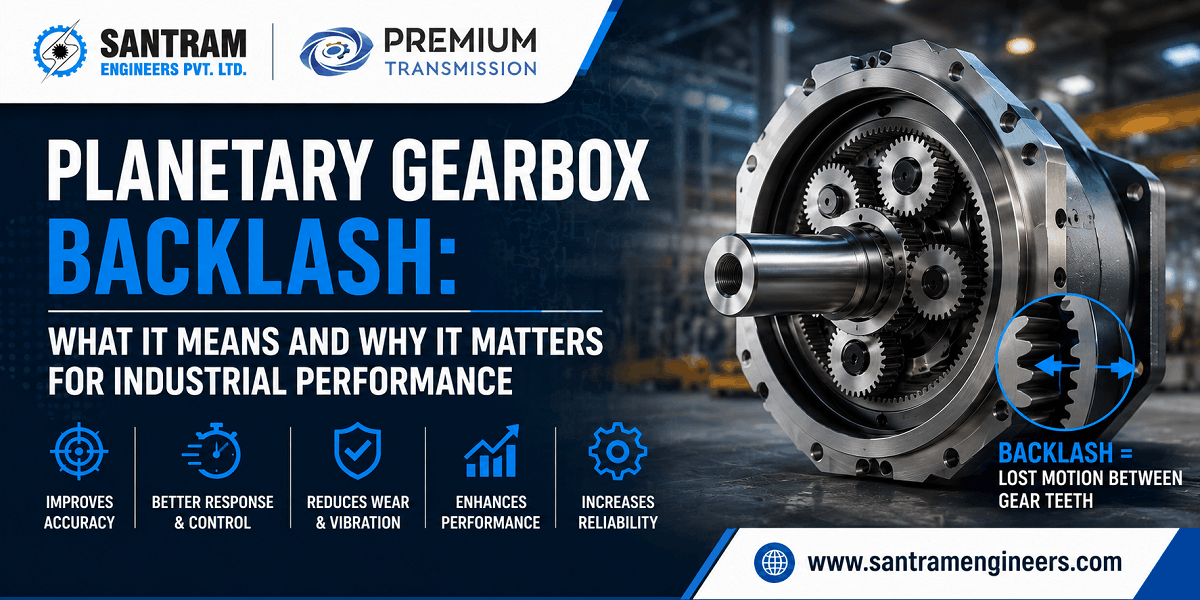
Backlash in a planetary gearbox is the small amount of lost motion or clearance between gear teeth when the direction of rotation changes. A controlled amount of backlash is normal, but excessive backlash can reduce accuracy, delay machine response, increase wear, and affect process consistency in industrial equipment. Backlash is commonly described as lost motion between mating gear teeth during bidirectional movement.
What Is Backlash in a Planetary Gearbox?
Backlash is the slight free movement that occurs before one gear tooth fully engages with another after direction changes.
For example, imagine a conveyor drive reversing direction. The motor shaft starts moving, but the output shaft takes a brief moment to respond. That small delay can be caused by the clearance between the gear teeth. This clearance is called backlash.
In a planetary gearbox, backlash is usually measured as angular movement, often in arc minutes. One arc minute equals 1/60 of one degree, and gearbox backlash is commonly expressed in this unit when precision matters.
Why Backlash Happens Between Gear Teeth
Backlash exists because gears cannot be manufactured, assembled, and operated with absolutely zero clearance in real industrial conditions. Gear teeth need some space to mesh smoothly, allow lubrication, handle thermal expansion, and avoid tooth interference.
If the gears are too tightly meshed, friction and heat can increase. This may damage the gear teeth, bearings, seals, and lubricant film. So, in many cases, backlash is not an accidental defect. It is a controlled design requirement.
Common reasons backlash exists include:
- Manufacturing tolerances
- Lubrication clearance
- Heat expansion
- Bearing fitment
- Gear tooth profile design
- Assembly and alignment requirements
Is Backlash Always a Problem?
No. Backlash is not always a problem.
A small, controlled amount of backlash helps a planetary gearbox operate smoothly. The issue begins when it becomes excessive or when the application requires high positioning accuracy.
A heavy-duty conveyor may tolerate more backlash than a servo-driven indexing system. Similarly, a mixer may not require the same precision as a robotic arm or automated packaging machine. The right backlash level depends on the application, not on a single universal number.
Why Planetary Gearbox Backlash Matters in Industrial Machinery
1. It Affects Motion Accuracy
In applications where motion needs to be repeated accurately, backlash directly affects output accuracy. This is important in automation equipment, feeders, indexing systems, packaging lines, and precision machinery.
Even a small angular gap can create visible deviation over distance. For example, 1 arc minute of backlash can create nearly 3 mm of deviation at a 10-metre radius, which shows why backlash matters in positioning-sensitive applications.
2. It Can Delay Machine Response
Backlash creates a delay between input movement and output movement. In one-direction continuous operation, this delay may not be obvious. But in machines that reverse, stop, start, or index frequently, delayed response becomes easier to notice.
This may affect:
- Start-stop accuracy
- Load positioning
- Synchronisation between machine sections
- Controlled movement during reversal
- Operator confidence in machine response
- For industrial plants, delayed response is not just a technical issue. It can affect cycle time, product handling, and production flow.
3. It Can Increase Wear Over Time
Excessive backlash can cause gear teeth to re-engage with impact when direction changes. This repeated impact can gradually increase tooth wear, bearing stress, vibration, and noise.
Over time, backlash may become worse because worn gears create more clearance. This creates a cycle: more backlash causes more impact, and more impact causes more wear.
4. It Can Impact Process Consistency
Many industries rely on consistency. If the drive system behaves differently during every start, stop, or reversal, the process may become less predictable.
This can affect:
- Material feeding
- Conveyor indexing
- Mixing quality
- Lifting control
- Packaging alignment
- Machine repeatability
For this reason, backlash should be considered as part of the overall industrial gearboxes’ performance, especially where smooth torque transfer and consistent motion matter.
How Backlash Works Inside a Planetary Gearbox
A planetary gearbox has a compact gear arrangement made of four main elements:
|
Component |
Role in the Gearbox |
| Sun gear | The central gear that receives input motion |
| Planet gears | Gears that rotate around the sun gear |
| Ring gear | Outer internal gear that meshes with planet gears |
| Carrier | Holds the planet gears and transfers the output motion |
This design allows the gearbox to transmit high torque in a compact space. However, because multiple gears are in mesh, small clearances at each contact point can influence overall output movement.
Why Backlash Can Build Up Across Gear Meshes
Backlash is not always limited to one gear pair. In a gear train, clearance from multiple mesh points can add up. This is especially important in multi-stage gearboxes where the output movement passes through more than one gear reduction stage.
A single small clearance may not cause a major issue. But when multiple clearances combine, the final output may show more lost motion than expected. This is why precision applications need careful backlash control from design to assembly.
How Load Sharing Influences Gearbox Performance
One advantage of a planetary gearbox is load sharing. Multiple planet gears carry the load instead of relying on one gear pair alone.
However, load sharing works best when the gear geometry, bearings, shaft alignment, and housing accuracy are correct. If one planet gear carries more load than the others, wear may become uneven. Over time, this may increase clearance and affect performance.
Common Causes of Excessive Planetary Gearbox Backlash
1. Gear Tooth Wear
Gear tooth wear is one of the most common reasons backlash increases over time. Heavy loads, long operating hours, shock loads, contamination, and poor lubrication can gradually change tooth profiles.
As the tooth surface wears down, the gap between mating gear teeth increases. This makes backlash more noticeable.
2. Improper Lubrication
Lubrication protects gear teeth by reducing friction, carrying heat away, and preventing metal-to-metal contact. If the oil level is low, the grade is wrong, or the oil is contaminated, internal wear can accelerate.
Both under-lubrication and over-lubrication can create problems. Under-lubrication increases friction, while the latter may generate heat and stress seals in some gearbox conditions.
3. Manufacturing and Assembly Tolerances
Backlash depends heavily on manufacturing accuracy. Gear tooth profile, pitch accuracy, bearing fitment, shaft alignment, housing machining, and assembly quality all influence backlash.
This is why buyers should not evaluate gearbox manufacturers only on price. Manufacturing capability, quality control, machining accuracy, and testing support can directly affect gearbox performance.
4. Overloading or Shock Loading
If a gearbox is exposed to loads beyond its rated capacity, internal parts experience higher stress. Repeated shock loads can damage gear teeth, bearings, shafts, and keyways.
Common examples include:
- Sudden conveyor jamming
- Load impact in crushers
- Heavy start-stop cycles
- Reversal under load
- Incorrect service factor selection
In these conditions, backlash can worsen more quickly.
5. Shaft Misalignment or Poor Mounting
Even a well-designed planetary gearbox can perform poorly if installation is incorrect. Misalignment between the motor, coupling, gearbox, and driven equipment can create uneven loading.
Poor mounting may also lead to vibration, bearing stress, seal issues, and gear mesh disturbance. Alignment should be checked during installation and periodically during operation.
6. Bearing Wear
Bearings support the internal gear arrangement and maintain correct alignment. When bearings wear out, the shaft or gear elements may shift slightly. This changes gear mesh conditions and can increase backlash.
Bearing wear may also show up as vibration, noise, heat, or unstable output movement.
Signs That Backlash May Be Affecting Gearbox Performance
1. Delay During Direction Change
If the machine reverses direction and the output movement responds late, backlash may be one possible cause.
2. Jerky or Uneven Motion
Jerky motion during start-stop operation can indicate internal clearance, worn components, or poor load transfer.
3. Reduced Positioning Accuracy
If a machine no longer reaches the same position consistently, backlash should be checked along with controls, couplings, bearings, and alignment.
4. Unusual Noise During Load Reversal
Clicking, knocking, or clunking sounds during reversal can suggest excessive clearance between components.
5. Increase in Vibration
Backlash may contribute to vibration, especially where load changes frequently or the gearbox operates under shock conditions.
6. Frequent Adjustment or Maintenance Requirement
If operators repeatedly adjust the machine to maintain performance, backlash may be part of the problem.
Where Planetary Gearbox Backlash Matters Most
1. Packaging and Automation Equipment
In packaging machinery, backlash can affect filling, sealing, cutting, positioning, and indexing. Even small movement errors may lead to misalignment or rejected output.
2. Conveyors and Material Handling Systems
Conveyors often run continuously, but many systems also stop, start, index, or reverse. Excessive backlash can affect load movement and drive response.
3. Cranes, Hoists, and Lifting Equipment
In lifting applications, controlled motion is critical. Backlash may affect load holding, reversal smoothness, and operator control.
4. Mixers, Agitators, and Process Equipment
Mixers and agitators need stable torque transmission. Excessive backlash may not always affect accuracy, but it can increase wear and reduce drive smoothness.
5. Robotics, Servo Systems, and Precision Machinery
Low backlash is especially important in robotics, CNC equipment, servo systems, and automated positioning. In these applications, even small lost motion can affect repeatability.
How Much Backlash Is Acceptable in a Planetary Gearbox?
Why There Is No Universal Backlash Value
There is no single backlash value that is right for every planetary gearbox application. Acceptable backlash depends on the machine type, operating conditions, required accuracy, and duty cycle.
Some manufacturers offer low-backlash precision gearboxes, while heavy-duty industrial gearboxes may be selected more for torque capacity, durability, and load handling.
How Application Type Decides Backlash Requirement
| Application Type | Backlash Sensitivity |
Main Concern |
| Conveyor drive | Low to medium | Smooth movement and reliability |
| Mixer or agitator | Low | Torque transmission and durability |
| Crane or hoist | Medium | Controlled movement and safety |
| Packaging machine | High | Positioning and repeatability |
| Robotics/servo system | Very high | Precision and motion control |
Why Low Backlash Is Not Always Required for Every Application
Low backlash is useful, but it is not always the only goal. A plant should not pay for ultra-low backlash if the application does not need it.
For heavy-duty industries, the better question is: what backlash level is acceptable for the machine’s real operating conditions? The answer should consider torque, load type, shock load, service factor, speed, alignment, lubrication, and maintenance access.
How to Reduce the Risk of Excessive Backlash
1. Choose the Gearbox Based on Application Requirements
Do not select a gearbox only by motor power. A proper selection should consider output torque, reduction ratio, load cycle, duty hours, start-stop frequency, shock load, and mounting position.
2. Specify Backlash Expectations Clearly
If the machine requires accuracy, mention the required backlash range before purchase. This helps suppliers recommend a suitable gearbox instead of a generic model.
3. Ensure Proper Installation and Alignment
Correct installation protects gear mesh quality. Check foundation, coupling alignment, shaft fitment, mounting orientation, and driven equipment alignment.
4. Follow Correct Lubrication Practices
Use the recommended lubricant grade and maintain the right oil level. Also check oil contamination, leakage, temperature, and service intervals.
5. Monitor Early Warning Signs
Routine inspection should include:
- Noise
- Vibration
- Temperature
- Oil condition
- Leakage
- Delayed response
- Abnormal movement
Early detection can prevent costly failure.
6. Work With an Experienced Planetary Gearbox Supplier
An experienced supplier understands that every application is different. The right partner will evaluate operating conditions, not just catalogue ratings.
For industries comparing industrial gearboxes, this support can make the difference between reliable performance and repeated downtime.
Questions Buyers Should Ask Before Selecting a Planetary Gearbox
Before selecting a planetary gearbox, buyers should ask:
- What is the required output torque?
- What is the reduction ratio?
- Does the application reverse direction frequently?
- Is positioning accuracy important?
- What backlash range is acceptable?
- What are the shock load conditions?
- What is the operating environment?
- What mounting position is required?
- Is local service and spare parts support available?
These questions help buyers move beyond basic specifications and choose a gearbox that matches the real application.
Why Backlash Should Not Be Ignored in Industrial Gearbox Performance
Backlash may be small in measurement, but it can have a large effect on industrial performance. It can influence how quickly a machine responds, how accurately it moves, how smoothly it handles load changes, and how long internal components last.
Ignoring backlash can lead to:
- Reduced accuracy
- Poor repeatability
- Higher wear
- More vibration
- Increased maintenance
- Production inconsistency
- Unexpected downtime
For plant engineers and procurement teams, backlash should be considered during gearbox selection, inspection, troubleshooting, and replacement planning.
Frequently Asked Questions (FAQs)
1. What is backlash in a planetary gearbox?
Backlash in a planetary gearbox is the small clearance or lost motion between gear teeth when the direction of rotation changes.
2. Is backlash normal in a planetary gearbox?
Yes. A controlled amount of backlash is normal because gears need clearance for lubrication, heat expansion, and smooth operation.
3. Why does planetary gearbox backlash matter?
It matters because excessive backlash can affect accuracy, response time, wear, vibration, and production consistency.
4. What causes excessive backlash in a planetary gearbox?
Common causes include gear tooth wear, poor lubrication, shock loading, misalignment, bearing wear, and manufacturing or assembly tolerances.
5. Can planetary gearbox backlash be reduced?
Yes. It can be controlled through proper gearbox selection, accurate installation, correct lubrication, regular inspection, and choosing a suitable supplier.
6. Where is low backlash important?
Low backlash is important in robotics, servo systems, packaging machines, automation equipment, and applications requiring repeatable positioning.
Choose the Right Planetary Gearbox for Reliable Performance
Backlash is only one factor that decides gearbox performance, but it can make a major difference in accuracy, reliability, and machine life. If your equipment needs smooth torque transmission, controlled movement, and dependable operation, choosing the right planetary gearbox is essential.
Santram Engineers helps industries evaluate torque, ratio, duty cycle, mounting, load conditions, and performance requirements before recommending a suitable gearbox. Whether you need a replacement gearbox, application guidance, or support from experienced gearbox suppliers, Santram Engineers can help you make a confident decision.
Get in touch with us at +91 96247 39393 or drop us an email at sales@santramengineers.com to find the right gearbox for your machinery.