
Why Worm Gearboxes Overheat — and How to Prevent It

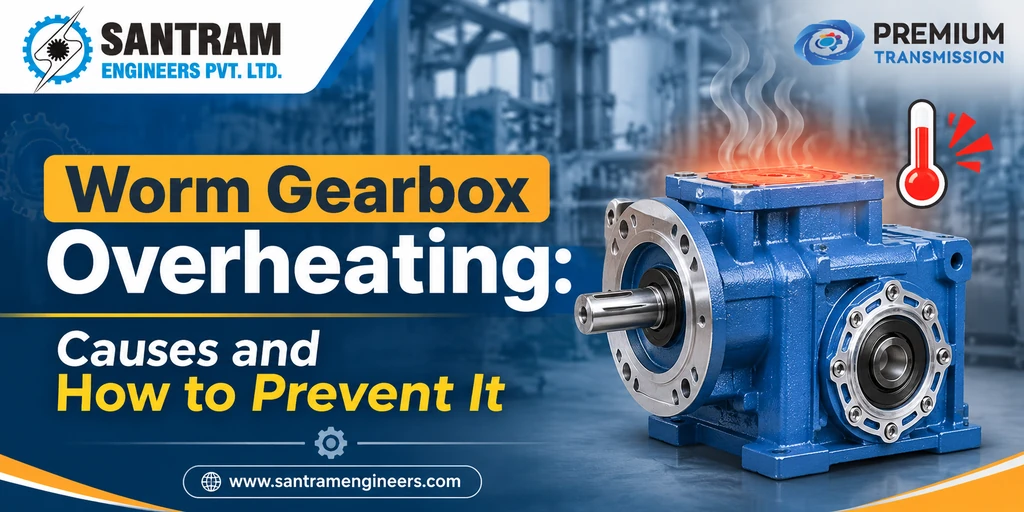
Put your hand on a worm gearbox mid-shift and you will feel it running warm — often noticeably warmer than a comparable helical or bevel unit doing the same job. Sometimes that warmth is completely normal. Sometimes it is an early warning sign of a failure building over weeks. Knowing the difference is what separates a preventive intervention from an unplanned shutdown.
Worm gearbox overheating is one of the most frequently misread symptoms in industrial power transmission maintenance. Because worm units are inherently less thermally efficient than other gearbox types, plant engineers sometimes dismiss early warning signs until the heat has already damaged the bronze wheel, degraded the oil, or begun destroying the bearings. This post explains why worm gearboxes run warm by design, what causes them to run dangerously hot, and what you can do about it — from field checks through to correct specification.
Worm gearbox overheating — direct answer: Worm gearbox overheating occurs when heat generated at the sliding-contact mesh between the steel worm and bronze worm wheel exceeds the unit’s thermal dissipation capacity. Unlike rolling-contact gearboxes, worm units convert 40–60% of input energy to heat at high reduction ratios, making them inherently prone to thermal overload when undersized, incorrectly lubricated, poorly ventilated, or run beyond their rated duty cycle.
The critical distinction is between a unit that stabilises at a warm but acceptable temperature and one whose temperature keeps climbing. A worm gearbox that reaches 75°C and holds that temperature under steady load is operating within normal parameters. One that climbs past 80°C without stabilising is telling you something is wrong — and the causes are almost always identifiable before failure occurs.
Why Worm Gearboxes Run Hotter Than Other Gearbox Types
The heat issue starts at the fundamental mechanics of how the worm meshes with the wheel. In a helical or spur gearbox, the dominant contact motion between gear teeth is rolling — the contact surface rolls across the mating tooth with relatively little sliding. In a worm gearbox, the contact is dominated by sliding. The steel worm threads across the face of the phosphor bronze worm wheel over the entire mesh cycle, generating significant friction across a large contact area.
That sliding friction has a direct and measurable thermal consequence: worm gearboxes are inherently less mechanically efficient than other gear types, and the gap grows sharply at high reduction ratios. A worm unit at a 10:1 reduction ratio typically achieves 85–92% efficiency. The same unit at 40:1 may achieve only 60–70% efficiency. At 60:1, efficiency can fall to 40–55% — which means 45–60% of the input power is rejected as heat rather than converted to useful output torque. For an application drawing 5 kW of input power at a 60:1 ratio, up to 3 kW may be generating heat in the gearbox housing continuously. Understanding worm gearbox efficiency by ratio and thread starts is essential context for sizing decisions at any ratio above 20:1.
The phosphor bronze worm wheel compounds this. Bronze has significantly lower thermal conductivity than steel, so heat generated at the mesh surface dissipates more slowly back through the wheel and into the housing. In a constrained or poorly ventilated installation, this localised heat accumulates at the mesh contact zone rather than spreading efficiently to the housing surface where it can radiate and convect away.
Manufacturers account for this by specifying two separate ratings for worm gearboxes: a mechanical torque rating and a thermal power rating. At high reduction ratios, the thermal rating is typically the more restrictive limit. Specifying only to mechanical torque capacity — common practice for helical gearboxes — leads to chronic worm gearbox overheating in continuous-duty applications.
The Most Common Causes of Worm Gearbox Overheating
Most overheating faults in service trace back to one of six causes. Overloading and incorrect lubrication together account for the majority of thermal failure cases seen in practice; the others are real but less frequent.
| Cause | Mechanism | Field Indicator |
|---|---|---|
| Overloading / undersized unit | Applied power exceeds the unit’s thermal rating; excess converts continuously to heat at the mesh | Temperature climbs steadily across the full shift without ever stabilising |
| Wrong or degraded lubricant | Insufficient film strength at the sliding mesh contact increases metal-to-metal friction and heat generation | Dark, sludgy oil on drain sample; acrid burnt smell when checking oil |
| Incorrect oil level | Under-fill starves the mesh of lubricant; over-fill increases internal churning losses — both raise temperature | Sight glass or dipstick reading outside the manufacturer’s fill mark range |
| Poor ventilation or high ambient | Restricts convective heat loss from the housing surface area; the gearbox cannot shed heat fast enough | Unit installed directly against a wall, inside a panel enclosure, or in a hot process area |
| Worn bearings or misalignment | Bearing friction adds a secondary heat load; misalignment creates uneven mesh loading and concentrated wear heat | Vibration or abnormal tone present alongside elevated temperature |
| Duty cycle mismatch | Unit rated for intermittent operation used in continuous or near-continuous service without derating | Temperature acceptable on short runs but climbs progressively on longer shifts |
Reading the Warning Signs Before Failure Occurs
Temperature alone is not the diagnostic. What matters is the temperature pattern over time, combined with any accompanying symptoms.
A worm gearbox running within its thermal rating will typically reach a stable operating temperature within 30–60 minutes of start-up under steady load, then hold at that level. The housing surface temperature may be 50–80°C depending on the unit size, load, ratio, and ambient conditions — that range is not unusual. What is not acceptable is a temperature that keeps climbing hour after hour without flattening. If the unit is at 65°C after one hour and 85°C after three hours with no change in load, the unit is rejecting more heat than its housing can dissipate.
Noise is a secondary indicator. A worm gearbox running hot due to bearing wear will often develop a grinding or whining tone that worsens as the unit heats further — bearing clearances change as metal expands under heat, and degraded lubrication accelerates the progression. Temperature rise with no noise change is more likely pointing to oil condition, ventilation, or duty than to mechanical wear.
Seal leakage alongside elevated temperature is worth examining carefully. Heat degrades elastomer seal material and reduces its flexibility, causing weeping at shaft seals. It can also indicate that the internal breather vent is blocked — trapped hot vapour builds pressure in the housing, pushing oil past seals that would otherwise hold. Checking and cleaning the breather vent is one of the fastest field checks available, and a blocked breather is a surprisingly common finding.
Practical Field Checks When a Worm Gearbox Runs Hot
When a unit is running hotter than expected, run these checks in sequence before drawing any conclusion about the root cause.
Check 1 — Has the duty changed?
The most common cause of sudden thermal issues in a previously stable unit is a change in operating load — a conveyor now carrying heavier product, a mixer running a higher-viscosity batch, a packaging line running at a faster cycle rate. If the duty has changed and the unit was sized for the original duty, the question is not how to cool the unit. The question is whether the unit is still correctly specified for the actual application. No amount of maintenance addresses a fundamental sizing mismatch.
Check 2 — Oil condition and level
Drain a small sample from the drain plug and examine it. Fresh worm gear oil is typically amber to light brown and translucent. Dark brown to black oil with a burnt or acrid smell has experienced sustained thermal oxidation — its film strength is already compromised, and replacing it is urgent but may not fully reverse the damage done to the wheel and bearings if the heat was prolonged. Check the oil level against the manufacturer’s fill mark. Both under-fill and over-fill generate excess heat, though by different mechanisms — under-fill through direct metal contact at the mesh, over-fill through churning losses as the worm thrashes through excess oil.
Check 3 — Ventilation and ambient environment
Measure the clearance around the unit. Many worm gearboxes are installed against walls, inside junction boxes, or in confined plant areas where convective airflow past the housing is minimal. The manufacturer’s minimum clearance recommendations exist for a thermal reason, not merely for access. For units in genuinely hot environments — near heat treatment furnaces, outdoor installations in regions with summer ambient temperatures above 40°C, or inside poorly ventilated enclosures — the baseline operating temperature is elevated regardless of load, and thermal derating of the unit may be required.
Check 4 — Vibration and noise profile
If elevated temperature is accompanied by vibration or a tone change, bearing condition becomes the priority. Bearing failure in a worm gearbox creates a thermal feedback loop: the bearing generates heat, the oil degrades faster at higher temperature, the degraded oil accelerates further bearing wear, and the bearing generates more heat. This loop can progress from “slightly warm with mild noise” to bearing failure in days if the initial warning is missed.
Check 5 — Temperature trend over a full run
If possible, log housing surface temperature at 15-minute intervals across a complete duty cycle using an infrared thermometer or a clip-on thermocouple. A unit that stabilises at 75°C and holds there is behaving correctly. A unit that is at 70°C after 30 minutes and 95°C by the end of a 4-hour shift has a progressive problem — the trend reveals a sizing or ventilation issue that a single temperature reading at any point in the shift would not fully communicate.
Prevention: Specification and Maintenance Practices That Eliminate Thermal Risk
Most worm gearbox overheating is preventable. The majority of field failures trace back to decisions made before the unit was ever installed — specifically, undersizing against thermal rating and incorrect lubricant selection.
When specifying a worm gearbox for continuous duty, verify the manufacturer’s thermal power rating (sometimes listed separately from mechanical torque rating in the datasheet). Apply a service factor appropriate for your duty cycle, starting frequency, and ambient temperature. At reduction ratios of 40:1 and above, the thermal rating is typically the governing specification limit — not the mechanical rating. Ignoring this distinction when sizing at high ratios is the single most common root cause of worm gearbox overheating in continuous-duty industrial applications. Thorough worm gearbox maintenance practices begin with correct specification — a correctly sized unit is far easier to maintain than one operating near its thermal ceiling.
For lubrication, use the manufacturer’s recommended grade. Most standard industrial worm units specify ISO VG 220 or VG 320 compounded mineral oil or equivalent. High-ratio applications, units with elevated ambient temperatures, or units under frequent start-stop cycling may warrant a synthetic worm gear oil — synthetics generally maintain film strength better at elevated temperatures, though they are not a substitute for correct grade selection. Change oil on the manufacturer’s schedule regardless of visual appearance: worm gear oil oxidises chemically before it shows obvious visual contamination, and running degraded oil accelerates bronze wheel wear.
Maintain clear airflow around the housing. Where ventilation is genuinely constrained by installation geometry, options include external fan units mounted on the housing, oil coolers on larger units, or upgrading to a housing frame with a provision for a cooling coil. For applications in high-ambient environments (above 40°C), consult the manufacturer’s thermal derating table — a unit with a thermal rating of 5 kW at 25°C ambient may be rated for only 3.5 kW at 45°C ambient.
When Replacement Is the Only Honest Answer
A worm gearbox that has been running significantly over temperature for weeks or months before the problem was identified often needs replacement rather than servicing. Sustained heat oxidises the oil, hardens and cracks seal material, accelerates bronze wheel wear, and causes bearing raceway fatigue — none of which is reversed by an oil change and clean.
The clearest indicator that a unit is beyond cost-effective servicing is repeated failure after correct maintenance: if a unit is overheating again within days of a full oil change and inspection, the unit is operating beyond its thermal capacity and the duty is the problem. The correct response is a properly sized replacement, not another service cycle. Understanding whether a situation calls for servicing or replacement is a decision worth working through carefully — a detailed look at gearbox servicing vs replacement covers the key criteria and cost considerations.
For units caught early — temperature elevated but no noise, no visible seal damage, oil changed, bearings confirmed good — a full service with fresh lubricant, breather clean, and load review can extend service life significantly. The difference between these two situations requires an honest assessment of load history and how long the unit has been running hot. A unit that has been hot for a week is a different case from one that has been progressively worsening for six months.
Frequently Asked Questions
How hot should a worm gearbox normally get?
Most worm gearboxes are rated for a maximum housing surface temperature of around 80–90°C under continuous duty, though the specific limit varies by manufacturer, unit size, and ambient conditions. The important check is not a single temperature reading but whether the unit reaches a stable temperature and holds it. A unit stabilising at 75°C under its rated load is behaving correctly; a unit climbing past 80°C without stabilising is not, regardless of where it started.
Can standard gear oil be used in a worm gearbox?
No. Worm gearboxes require oil formulated for sliding-friction contact — typically a compounded mineral oil or synthetic worm gear oil with appropriate extreme-pressure (EP) and anti-wear additives matched to bronze-on-steel contact. Standard industrial gear oil formulated for helical or spur gearboxes has a different additive package intended for rolling contact. Using it in a worm gearbox provides inadequate film strength at the mesh contact surface, which accelerates bronze wheel wear and raises operating temperature significantly.
Does fitting a cooling fan always fix worm gearbox overheating?
Not always. A cooling fan addresses heat dissipation — it helps the housing shed heat faster. If the root cause is overloading, the unit is generating more heat than its mechanical design is intended to handle, and a fan delays the progression rather than resolving it. Fans are most effective where the cause is restricted airflow or elevated ambient temperature. Where the cause is systematic overload, only reducing the applied power or upgrading to a larger thermal-rated unit resolves the issue.
Why does worm gearbox oil need changing more frequently than helical gearbox oil?
The sliding-friction contact in a worm gearbox generates higher localised temperatures at the mesh surface than rolling-contact gearboxes do under equivalent loads. This thermal stress oxidises the lubricant faster. Most manufacturers recommend an initial oil change at 300–500 operating hours on a new worm unit to remove metal particles from the run-in period, followed by interval changes every 2,000–4,000 hours depending on operating temperature and load. Units running continuously near their thermal rating may need changes at the shorter end of that range.
Can worm gearbox overheating affect self-locking behaviour?
Yes — this is an important safety consideration for vertical load-holding applications. Self-locking in a worm gearbox depends on a combination of lead angle and friction coefficient. When oil film breaks down from sustained overheating, friction characteristics at the mesh become unpredictable. In some degraded-oil conditions, friction can momentarily drop below the threshold that maintains self-locking. Any worm gearbox used for load holding in a safety-relevant application should be inspected and oil verified whenever elevated operating temperatures are observed.
How do I know if my worm gearbox is undersized?
The clearest sign is housing temperature that climbs steadily under normal duty without stabilising — particularly if this has been progressively worsening rather than appearing suddenly after a load change. Cross-check the actual applied load against the manufacturer’s thermal power rating (not just mechanical torque rating) for the installed unit at your operating reduction ratio and ambient temperature. If the applied continuous power exceeds the thermal rating, the unit is undersized for this application, and replacement with a unit of higher thermal capacity is the correct resolution.
If a worm gearbox in your plant is running hotter than it should, the cause is usually identifiable before it escalates to bronze wheel damage or bearing failure — but the window between an early thermal warning sign and irreversible wear is shorter than most engineers expect.
Santram Engineers (P) Limited supplies, services, and advises on worm gearboxes across a wide range of industrial applications. If you need help assessing whether a hot-running unit is worth servicing, sizing a replacement for the actual thermal demand of your application, or selecting the right lubricant grade, our team can help.
Contact us at sales@santramengineers.com or visit santramengineers.com to get in touch.


