How to Choose the Right Geared Motor for Industrial Applications

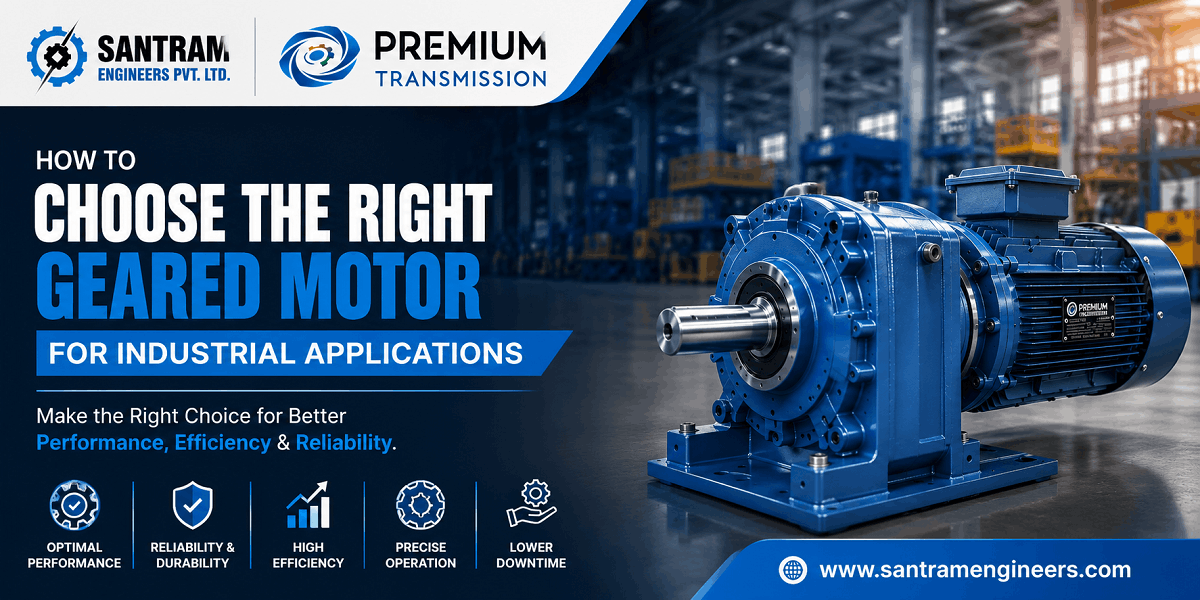
Wrong drive selection causes more downtime than many teams expect. A machine may be mechanically sound, yet still underperform because the drive is undersized, overspeeded, or matched to the wrong duty cycle. A geared motor is a compact drive unit that combines a motor with a gearbox to reduce speed, increase torque, and deliver controlled motion in industrial machines that require precision and reliability.
For industrial buyers, the right selection is not about choosing the biggest HP rating or the cheapest option. It comes down to matching torque, RPM, gear ratio, load type, duty cycle, mounting, environment, and control requirements to the application. That is how you improve transmission performance, reduce overheating, and avoid paying for avoidable failures later.
Santram Engineers, as a dealer, distributor, and supplier of industrial gearboxes and geared motors, is naturally positioned in this conversation because buyers usually need more than a product; they need application-fit guidance.
What Is a Geared Motor in Industrial Applications?
A geared motor is an integrated drive system that combines an electric motor with a gearbox to deliver controlled speed and higher output torque. The gearbox reduces output speed and multiplies torque, which is why geared drives are widely used in high-torque, low-speed industrial jobs. Manufacturers also use different configurations to reorient the output shaft when the machine layout demands it.
In practice, these drives show up in conveyors, mixers, packaging machines, material handling systems, lifting systems, food processing machinery, textile machinery, and automation systems. The exact selection changes by industry, but the selection logic stays the same: match the drive to the machine, not the other way around.
Start with the Application Requirement
Before comparing catalogue pages, define what the machine actually needs to do. Ask simple but important questions:
- What is being moved?
- How heavy is it?
- Does it run continuously or in cycles?
- Does it start under load?
- Does it reverse often?
- Is the motion slow, fast, or precise?
- Does the machine face a shock load or vibration?
These details shape the final drive choice.
This step matters because a geared motor that works perfectly on a light-duty machine may fail quickly on a loaded conveyor or a reversing mixer. Power alone does not tell the full story; torque, speed, gear ratio, and duty cycle decide the real performance.
A practical example: a 1 HP drive may look suitable on paper, but if the application needs high starting torque and frequent stops, the same rating can be too small. That is why experienced buyers always start with application data before final sizing.
Check the Required Torque
Torque is the turning force that moves the load. If the torque is too low, the geared motor may stall, draw excess current, overheat, or fail early. Manufacturers specify output torque because it tells you how much load the drive can actually move.
Starting torque and running torque are not always the same. A loaded conveyor, mixer, crusher, lifting system, or agitator may need much more torque at startup than during steady running. That is why the best selection is not just about “can it run?” but “can it start safely under real load?”
Undersizing a geared motor can lead to overheating, bearing stress, gear wear, nuisance tripping, and unplanned downtime. In industrial environments, it usually costs far more than selecting the correct size from the start.
Decide the Required Output Speed or RPM
Output RPM tells you how fast the machine will actually run after speed reduction. The gearbox lowers motor speed to the usable machine speed, and the right RPM depends on whether the application needs slow controlled motion, moderate speed, or faster throughput.
The relationship is simple: a higher gear reduction usually means lower output speed and higher torque. That is the core trade-off in most geared motor selections.
A common buying mistake is focusing only on HP or kW and ignoring output RPM. For example, if a motor runs at 1440 rpm and the machine needs about 48 rpm at the output shaft, a 30:1 ratio gives a starting point because 1440 ÷ 30 ≈ 48. The final selection still has to pass torque and service-factor checks.
Select the Right Gear Ratio
Gear ratio controls how much the motor speed is reduced and how much torque is multiplied. In simple terms, a higher ratio gives lower speed and higher torque, while a lower ratio gives higher speed and lower torque.
That is why the ratio should never be selected randomly. It should be chosen from the required output RPM, load condition, torque demand, and application type. Manufacturers use this logic because the wrong ratio creates poor machine performance even if the motor power looks correct.
When buyers compare geared motor manufacturers, the better ones are usually the ones that help match the ratio to the application instead of pushing a one-size-fits-all model. That support is part of what separates a standard product sale from a true premium transmission solution.
Consider Duty Cycle and Operating Hours
Duty cycle describes how the machine works over time. Continuous duty means long operating hours. Intermittent duty means short operating periods with breaks. Frequent start-stop duty means the drive starts, stops, reverses, or changes load often.
This matters because a geared motor used continuously needs enough thermal capacity and service margin to handle heat buildup. If the duty cycle is ignored, the drive may overheat even when torque and RPM look fine on paper.
Real factory conditions also matter. Long shifts, dust, heat, voltage fluctuation, and varying loads are normal in many industrial plants, so selection should reflect the actual operating environment rather than only catalogue ratings.
Match the Load Type and Service Factor
Different loads behave differently. Some are uniform, while others create moderate shock, heavy shock, reversing forces, overhung loads, or high inertia. Each load type changes how hard the drive has to work at startup and during operation.
Service factor is the extra capacity margin that helps the geared motor handle real-world operating conditions. Technical selection documentation shows that service factor plays an important role in proper gear unit selection, along with load type, operating conditions, and ambient temperature.
This is why two applications with the same HP and RPM may still need different ratings. A smooth-running conveyor is not the same as a reversing hoist or an agitator with a shock load.
Choose the Right Mounting Position and Shaft Arrangement
Mounting matters more than many buyers expect. Gearmotors are available in parallel-shaft, right-angle, and inline configurations, and manufacturers also provide a wide range of mounting positions and variants for different installation conditions.
Before buying, confirm whether the application needs a foot-mounted, flange-mounted, or shaft-mounted unit. Also, check whether the machine requires an inline shaft arrangement, a right-angle arrangement, a hollow shaft, or a solid shaft. Vertical and horizontal mounting can also affect installation and operation.
This decision affects lubrication, alignment, maintenance access, and long-term reliability. A compact gearbox can perform very well in a tight space, but only if the mounting position matches the machine design from the start.
Evaluate the Operating Environment
The environment affects insulation, lubrication, sealing, coating, and bearing life. Heat, dust, moisture, outdoor exposure, and washdown conditions all change how a geared motor should be specified.
That is why manufacturers offer different solutions for different environments, including stainless steel and explosion-proof designs, along with compact wash-down styles for hygiene-sensitive operations.
Check these conditions before final selection:
- Dusty factories
- High-temperature areas
- Humid or washdown areas
- Outdoor installations
- Chemical exposure
- Food-grade or hygiene-sensitive spaces
- Flameproof or hazardous zones, where applicable
A lower-cost drive may become expensive if it fails early because the sealing, insulation, or protection rating was not suited to the plant environment.
Check Efficiency and Power Consumption
Efficiency matters most in long-running operations. A geared motor that runs for many hours each day affects energy cost, heat generation, and system reliability. Manufacturers increasingly promote high-efficiency and compact system designs because total operating cost matters as much as purchase price.
That is also why buyers should not choose only based on the lowest price. Total cost of ownership includes energy use, downtime, replacement frequency, spare availability, maintenance effort, and technical support. A better drive often pays back through fewer problems and lower operating waste.
Efficiency becomes especially important in continuous conveyors, process plants, packaging lines, food processing, material handling, and multi-shift factories. Drives control motor speed to match the task and improve performance, which is why drive matching matters so much in plant design.
Match the Geared Motor with the Application Type
|
Application |
Selection Focus |
| Conveyors | Torque, belt load, speed, start-stop frequency |
| Mixers and agitators | Starting torque, shock load, duty cycle |
| Lifting systems | Holding torque, safety, and braking requirements |
| Packaging machinery | Speed control, compact design, smooth operation |
| Food processing | Hygiene, efficiency, corrosion resistance |
| Textile machinery | Speed consistency and continuous operation |
| Steel/cement plants | Heavy-duty load, dust, heat, and reliability |
Note: This table is not about selling a specific product line. It is a practical buying shortcut: match the drive to the machine behaviour, then refine by environment and mounting.
Check Compatibility with Brakes, VFDs, and Controls
A brake geared motor is useful when the application needs holding, indexing, positioning, or safe stopping in lifting and motion-control tasks. Brake-equipped geared drive systems commonly include hand-release mechanisms, which reflects how widely brake integration is used in industrial motion-control applications.
VFD compatibility matters when the machine needs speed variation, soft starting, controlled acceleration, or energy savings. The drive must supply the required voltage and current to produce the torque the application needs, which is why motor and VFD ratings should always match the operating requirement.
Electrical and mechanical selection should work together. Voltage, phase, frequency, control panel compatibility, and protection requirements all influence whether the system will run safely and consistently.
Compare Standard vs Custom Geared Motor Requirements
A standard geared motor is often enough for common conveyors, packaging equipment, light-duty machinery, and predictable load conditions. Manufacturers build modular systems for this reason: they can cover many applications without starting from scratch every time.
Custom selection becomes more important when the application has heavy shock loads, space restrictions, special mounting, high ambient temperature, specific output RPM, high torque at low speed, or harsh industrial conditions. Different product configurations and mounting variants show how strongly real-world installation constraints influence the final drive selection.
This is where expert consultation adds real value. Buyers do not only need a product list; they need help translating machine data into the right drive specification.
Checklist Before Buying a Geared Motor
Before finalising the purchase, check the following:
- Required output torque
- Required output RPM
- Gear ratio
- Motor power rating
- Load type
- Duty cycle
- Mounting position
- Shaft type and direction
- Operating environment
- Braking requirement
- VFD/control compatibility
- Service factor
- Brand and quality
- Spare availability
- Supplier/dealer support
This checklist is the fastest way to prevent mismatches and to compare geared motor manufacturers on more than just price. It also helps buyers evaluate whether they are getting a true premium transmission solution or just a catalogue unit.
Conclusion
Choosing the right geared motor is not about picking the highest HP or the lowest price. It is about matching torque, speed, gear ratio, load type, duty cycle, mounting, environment, and controls to the real operating requirement. When those factors are aligned, the result is smoother motion, lower downtime, better efficiency, and longer service life.
For industrial buyers, the smartest approach is to treat drive selection as an engineering decision, not a purchase shortcut. That is exactly where Santram Engineers can help.
Frequently Asked Questions (FAQs)
1. How do I choose the right geared motor?
Choose it by matching torque, output RPM, gear ratio, load type, duty cycle, mounting, environment, and control requirements to the application.
2. What is the difference between a motor and a geared motor?
A motor provides rotation, while a geared motor combines the motor with a gearbox to reduce speed and increase torque for industrial use.
3. Why is torque important in geared motor selection?
Torque determines whether the drive can actually move the load without stalling, overheating, or tripping.
4. How does gear ratio affect geared motor performance?
A higher gear ratio usually means lower output speed and higher torque, while a lower ratio gives higher speed and lower torque.
5. Which geared motor is best for industrial use?
The best one is the one matched to the application. Conveyor, mixer, lifting, packaging, and process equipment all need different torque, speed, and mounting considerations.
6. Is it possible to control a geared motor with a VFD?
Yes, when the motor and drive ratings are compatible with the supply voltage, current, and torque requirements of the application.
Ready to Choose the Right Geared Motor?
Choosing the right geared motor can make the difference between smooth, efficient production and costly breakdowns. At Santram Engineers, we help industrial buyers move beyond guesswork with application-focused guidance on torque, RPM, duty cycle, mounting, and operating conditions.
Whether you need a drive for conveyors, mixers, lifting systems, or continuous process equipment, our team can help you identify the right solution with confidence. Partner with us for reliable sourcing, technical clarity, and performance-driven geared motor selection that supports long-term productivity.
Reach out today at +91 96247 39393 or at sales@santramengineers.com and make your next drive decision a smarter one.