How to Select the Perfect Gearbox for Conveyor Systems

Selecting the right gearbox for your conveyor system is essential to ensure efficient performance, reliability, and cost-effectiveness. A conveyor system is the backbone of many industrial operations, and the gearbox plays a vital role in ensuring smooth and controlled movement. The wrong choice can lead to costly breakdowns, inefficiencies, or even safety issues. In this guide, we explore the critical factors to consider when choosing a gearbox for a conveyor system. We cover gearbox selection for belt conveyors, chain conveyors, and screw conveyors — including the torque and power calculations engineers use in India — and highlight Premium Transmission Limited as a trusted provider.
The Role of a Gearbox in Conveyor Systems
A gearbox in a conveyor system serves as a power transmission component, controlling speed and torque. It helps convert the high-speed input from a motor into the slower speed needed to drive the conveyor. The gearbox also ensures the right amount of torque is applied to move heavy loads efficiently without putting undue strain on the system. This balance is crucial, as it affects the operational efficiency and longevity of the conveyor. Premium Transmission Limited, a leading name in industrial gear solutions, offers reliable gearboxes designed for various conveyor applications, ensuring smooth and efficient operation.
Key Factors to Consider When Choosing a Gearbox for Conveyor
Load Capacity and Torque Requirements
Understanding your conveyor system’s load capacity and torque requirements is the first step in selecting the appropriate gearbox. The gearbox must be able to handle the maximum load without overloading. Choosing a gearbox with the right torque ensures the system operates efficiently without unnecessary wear. Too little torque can lead to performance issues, while excessive torque may increase energy consumption and reduce the life of the system. When considering the conveyor gearbox price in India, balancing cost with performance is key to achieving long-term operational efficiency.
Operating Conditions
The environmental conditions in which the conveyor operates play a crucial role in gearbox selection. Factors like temperature, humidity, dust, and exposure to corrosive materials can impact the performance and longevity of a gearbox. For example, if your conveyor operates in a high-temperature environment, you’ll need a gearbox that can handle heat without compromising efficiency. Similarly, gearboxes exposed to harsh or corrosive environments may require special coatings or seals to prevent damage. Premium Transmission Limited offers a range of gearboxes designed to withstand diverse operating conditions, ensuring durability and optimal performance.
Speed and Gear Ratio
The required speed of your conveyor and the gear ratio of the gearbox are closely linked. A high gear ratio will result in slower conveyor speed but higher torque, while a low gear ratio will provide faster speeds with lower torque. Depending on the application — whether moving heavy materials or high-speed sorting — choosing the right speed and gear ratio is essential. Ensuring the correct balance between speed and torque improves productivity and reduces the likelihood of mechanical stress on the conveyor system.
Types of Gearboxes Suitable for Conveyors
Selecting the right type of gearbox for your conveyor system is crucial for ensuring optimal performance, efficiency, and longevity. Each type of gearbox offers unique benefits and is suited to specific applications. Below, we explore the most common types of gearboxes used in conveyor systems and their respective advantages.
Helical Gearbox
A helical gearbox is one of the most commonly used gearboxes in conveyor systems due to its efficiency and smooth power transmission. The teeth of helical gears are cut at an angle, which allows them to engage more gradually compared to spur gears. This design reduces noise and vibration while providing higher load-carrying capacity.
Benefits and Applications:
- Excellent for conveyors that require continuous and smooth operation.
- High efficiency, making it suitable for energy-conscious businesses.
- Used in various industries like food processing, material handling, and packaging.
- Its efficiency and quiet operation make it ideal for longer conveyor systems.
Premium Transmission Limited offers high-quality helical gearboxes that are known for their durability and low maintenance needs, making them a reliable choice for conveyor applications.
Worm Gearbox
A worm gearbox features a worm gear meshing with a worm wheel, which allows for a high reduction ratio in a compact design. However, they are generally less efficient than helical or bevel gearboxes due to higher friction.
Features, Pros, and Cons:
- Compact and cost-effective, making it a good option where space is limited.
- High reduction ratios with fewer components.
- Lower efficiency and higher heat generation compared to other types.
- Ideal for conveyors with low-speed, high-torque requirements.
Worm gearboxes are often chosen when budget constraints are a priority. However, the price can vary depending on the model and specifications.
Bevel Helical Gearbox
The bevel helical gearbox is designed for heavy-duty applications, making it ideal for conveyors that handle large loads or operate under harsh conditions. This type of gearbox combines the advantages of bevel gears and helical gears, providing both high efficiency and strength.
Best Uses for Heavy-Duty Applications:
- Suitable for mining, quarrying, and heavy manufacturing.
- High torque transmission capability.
- Long-lasting and durable, reducing maintenance costs over time.
Planetary Gearbox
A planetary gearbox is highly efficient and compact, making it suitable for specialized applications where space is a premium, and high torque is required.
Benefits and Applications:
- Best suited for conveyors with high-precision requirements.
- Frequently used in automation, robotics, and complex material handling systems.
- Provides high efficiency and compactness for space-constrained applications.
Businesses can rely on Premium Transmission Limited for a variety of gearbox solutions, including planetary gearboxes, ensuring optimal performance for their conveyor systems.
Gearbox for Screw Conveyors
A screw conveyor (also called an auger conveyor) uses a rotating helical screw blade to move granular or liquid materials along a tube or trough. They are widely used in Indian industries for handling cement, fertiliser, grain, coal, sand, and chemical powder. Because the screw shaft rotates continuously under load, the gearbox selection for a screw conveyor has specific requirements that differ from belt or chain conveyors.
Recommended gearbox types for screw conveyors:
- Helical inline gearbox (foot or flange-mounted): The preferred choice for most horizontal and low-inclination screw conveyors. High efficiency (92–96%), compact axial profile, and direct shaft coupling make inline helical gearboxes the standard for screw conveyor drives in cement plants, fertiliser plants, and food-processing units.
- Helical bevel gearbox (right-angle output): Used where the motor and screw shaft must be at 90°, common in space-constrained installations or where a side-entry drive is required.
- Worm gearbox: Suitable for small screw conveyors with low capacity (below 10 t/h) and low-speed requirements where cost is a priority over efficiency. Not recommended for continuous-duty, high-capacity screw conveyors because of heat buildup.
Key parameters for screw conveyor gearbox selection:
- Output RPM: Screw conveyors typically run at 50–150 RPM for heavy materials (cement, sand), and up to 200–300 RPM for lighter materials (grain, flour). A standard 4-pole motor at 1,450 RPM requires a gear ratio of approximately 10:1 to 29:1 for this range.
- Required torque: Determined by the material, screw diameter, pitch, length, and inclination — see the calculation section below.
- Service factor: Apply a service factor of 1.25–1.5 for uniform loads (grain, flour) and 1.5–2.0 for heavy or abrasive materials (cement, sand, coal).
- Mounting: Screw conveyor drives are typically foot-mounted or flange-mounted to the conveyor trough end plate. Confirm the gearbox mounting configuration matches the conveyor’s shaft centre height and bolt pattern before ordering.
Gearbox for Chain Conveyors
Chain conveyors — including drag chain conveyors, slat conveyors, and roller chain conveyors — are widely used in steel plants, cement factories, foundries, automotive assembly lines, and bulk material handling. The chain is driven by a sprocket mounted on the gearbox output shaft, which places different demands on the gearbox compared to belt or screw conveyors.
Recommended gearbox types for chain conveyors:
- Bevel helical gearbox (right-angle output): The most common choice for chain conveyors. The right-angle output aligns naturally with the drive sprocket, and the high torque capacity handles the shock loads from chain engagement. Used in drag chain conveyors for ash handling, clinker transport, and heavy slat conveyors.
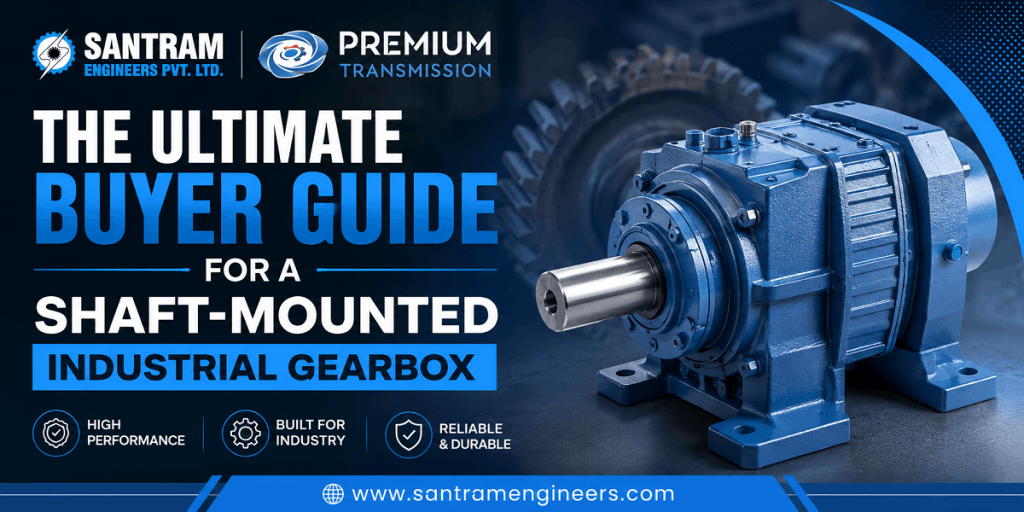
- Shaft-mounted gearbox: Mounts directly on the drive shaft of the head sprocket without a separate coupling or base plate. This eliminates shaft misalignment problems, reduces installation time, and is the standard for medium-duty scraper chain and apron conveyors. A torque arm anchors the gearbox to the conveyor frame.
- Helical inline gearbox: Used where the drive sprocket is positioned in line with the motor — typical for smaller roller chain conveyors in packaging, food processing, and automotive assembly. A coupling connects the gearbox output shaft directly to the sprocket shaft.
Key parameters for chain conveyor gearbox selection:
- Chain speed: Heavy drag chain and slat conveyors run at 0.05–0.3 m/s. Roller chain conveyors in lighter applications may run at 0.3–1.0 m/s. Calculate the required output RPM from the sprocket pitch diameter and chain speed.
- Service factor: Chain conveyors have higher shock loading than belt conveyors due to chain polygon effect and engagement. Apply a service factor of 1.50–2.00 for most chain conveyors, and 2.00–2.50 for very heavy or abrasive duty (clinker, ash, foundry sand).
- Mounting arrangement: Confirm the gearbox output shaft direction and mounting face match the conveyor’s drive head layout before ordering. Shaft-mounted units require a torque arm and a hollow bore output shaft sized to the sprocket shaft diameter.
Gearbox Calculation for Conveyor Systems
Correct gearbox sizing begins with calculating the power and torque the conveyor actually requires, then adding a service factor margin. Undersizing leads to premature gearbox failure; oversizing wastes capital and can result in a larger, heavier unit that is harder to mount. Below are the standard calculations used by conveyor engineers in India.
Step 1: Calculate Required Power (kW)
For belt conveyors:
P = (F × v) / 1000
Where:
- P = required power in kW
- F = total effective pull force at the drive pulley, in Newtons (N)
- v = belt speed in m/s
Total pull force (F) = Resistance force (friction) + Force to lift material (on inclined conveyors)
F = [μ × (mbelt + mload) × g] + [(mload) × g × sin θ]
Where μ = friction coefficient (typically 0.02–0.04 for roller-supported belts), m = mass in kg, g = 9.81 m/s², θ = inclination angle.
For screw conveyors (horizontal or inclined):
The most widely used formula (ISO 7119 / CEMA standard):
P = (Q × L × Cf) / 367
Where:
- P = required shaft power in kW
- Q = material capacity in tonnes per hour (t/h)
- L = screw conveyor length in metres (m)
- Cf = material factor (see table below)
- 367 = constant derived from unit conversions
For inclined screw conveyors, add the lifting power:
Pincline = (Q × H) / 367
Where H = vertical rise in metres. Total power = P (horizontal) + Pincline.
Material Factor (Cf) reference table:
| Material | Bulk Density (kg/m³) | Material Factor Cf |
|---|---|---|
| Wheat, rice, grain | 700–800 | 0.40 |
| Cement (dry) | 1,100–1,500 | 1.20 |
| Fly ash | 700–900 | 0.80 |
| River sand (dry) | 1,400–1,600 | 1.50 |
| Coal (crushed) | 800–900 | 0.70 |
| Fertiliser (granular) | 900–1,000 | 0.80 |
| Salt | 1,100–1,200 | 1.00 |
| Limestone (crushed) | 1,400–1,600 | 1.40 |
For chain conveyors:
P = (Ftotal × v) / 1000
Where:
- P = required power in kW
- Ftotal = total chain pull force in Newtons (N)
- v = chain speed in m/s
Total chain pull force:
Ftotal = [μ × (mchain + mload) × g] + [(mload) × g × sin θ]
Where μ = friction coefficient for chain on steel (0.15–0.20 for dry running, 0.10–0.15 for lubricated), m = mass in kg, g = 9.81 m/s², θ = inclination angle.
Quick example — drag chain conveyor (coal handling):
Chain weight = 80 kg/m, conveyor length = 20 m, coal load = 500 kg, chain speed = 0.15 m/s, μ = 0.18 (dry).
Ftotal = 0.18 × (80×20 + 500) × 9.81 = 0.18 × 2,100 × 9.81 = 3,709 N
P = (3,709 × 0.15) / 1,000 = 0.56 kW → Apply Sf = 1.75 → Pdesign = 0.98 kW
Select a bevel helical gearbox rated ≥ 1.1 kW with output RPM matching the sprocket speed.
Step 2: Apply Service Factor
Multiply the calculated power by the appropriate service factor (Sf) before selecting the gearbox:
Pdesign = P × Sf
| Operating Condition | Service Factor (Sf) |
|---|---|
| Uniform load, up to 8 hours/day (grain, flour, light belt conveyor) | 1.00 – 1.25 |
| Moderate shock, 8–16 hours/day (belt conveyor, light chain conveyor) | 1.25 – 1.50 |
| Heavy shock or abrasive material (cement, sand, drag chain), up to 24 hours/day | 1.50 – 2.00 |
| Very heavy shock, abrasive, continuous (mining, quarrying, clinker chain conveyor) | 2.00 – 2.50 |
Step 3: Calculate Output Torque and Gear Ratio
Once design power is known, calculate the required output torque:
Toutput = (9,550 × Pdesign) / noutput
Where:
- Toutput = output torque in Newton-metres (Nm)
- Pdesign = design power in kW
- noutput = required output shaft speed in RPM
The gear ratio required is:
i = nmotor / noutput
For a standard 4-pole motor at 1,450 RPM driving a screw at 100 RPM, the required gear ratio is 14.5:1. Select the nearest available ratio from the gearbox manufacturer’s catalogue and confirm the catalogue torque rating exceeds Toutput.
Quick example — cement screw conveyor:
Q = 20 t/h, L = 12 m, Cf = 1.20 (cement), Sf = 1.75 (abrasive, 16 h/day), noutput = 80 RPM.
P = (20 × 12 × 1.20) / 367 = 0.785 kW → Pdesign = 0.785 × 1.75 = 1.37 kW
Toutput = (9,550 × 1.37) / 80 = 164 Nm
Select a helical inline gearbox with an 18:1 ratio (nearest to 1450/80 = 18.1:1) and catalogue output torque ≥ 164 Nm. A Premium Transmission helical inline unit at 1.5 kW / ratio 18 would comfortably cover this application.
Comparison Chart Highlighting Advantages and Disadvantages of Each Type
| Gearbox Type | Advantages | Disadvantages | Conveyor Suitability |
|---|---|---|---|
| Helical Inline | High efficiency (92–96%), compact, quiet, low maintenance | Higher initial cost than worm | Belt conveyors, screw conveyors, roller chain conveyors (inline drive) |
| Worm Gearbox | Compact, cost-effective, high reduction ratio in one stage | Lower efficiency (60–85%), higher heat generation, more wear | Small screw conveyors (below 10 t/h), low-duty belt conveyors |
| Bevel Helical | High torque capacity, right-angle output, heavy-duty | Larger size, higher cost | Heavy belt conveyors, drag chain conveyors, slat conveyors, mining applications |
| Shaft-Mounted | No coupling or base plate required, eliminates shaft misalignment | Requires torque arm, hollow bore must match shaft diameter | Chain conveyors (apron, scraper, drag chain) — direct drive on head sprocket shaft |
| Planetary Gearbox | Compact, high precision, ideal for high-torque applications | Complex design, higher cost | High-precision conveyors, automation, robotics |
This comparison helps businesses evaluate different gearbox options and balance performance, cost, and suitability for their conveyor systems.
Importance of Efficiency and Energy Savings
Selecting the right gearbox for conveyor systems is not just about performance. It directly affects energy consumption and overall operational costs. An efficient conveyor gearbox reduces energy loss during transmission, resulting in significant energy savings over time. This can lower operational costs, especially in systems that run continuously. With the rising cost of energy, improving efficiency is a top priority for many businesses.
Premium Transmission Limited offers advanced gearbox designs that focus on energy efficiency, minimizing friction and heat loss. These modern gearboxes feature high-quality components, such as precision-cut gears and advanced lubrication systems, that enhance performance while reducing energy waste.
The impact of an efficient gearbox goes beyond energy savings. It also extends the life of the conveyor system by reducing wear and tear on both the gearbox and motor. This minimizes maintenance costs, downtime, and ultimately the total cost of ownership.
Advanced features to look for include automatic lubrication, variable speed control, and optimized gear geometry. These features ensure smoother operation and further improve energy efficiency, making a significant difference in long-term cost savings and productivity.
Frequently Asked Questions
1. What is the function of a gearbox in a conveyor system?
A gearbox for conveyor systems plays a critical role in converting the speed and torque of the motor into the optimal levels required for operation. It helps regulate the speed and direction of the conveyor while providing the necessary torque to move materials efficiently. Without a properly selected gearbox, the conveyor may operate inefficiently, leading to potential mechanical failure or reduced productivity. A reliable gearbox ensures smooth operation, reduces strain on the motor, and minimizes energy consumption.
2. How do I determine the correct size of a gearbox for my conveyor?
Choosing the correct size of a conveyor gearbox involves calculating key parameters like load capacity, torque, and speed. Begin by identifying the maximum load the conveyor will need to move and the required torque to handle that load. Additionally, the speed of the conveyor and the motor power should be factored in. Consulting with experts such as Santram Engineers, which offers a range of gearbox solutions from Premium Transmission Limited, can help ensure you select the right size and type of gearbox for your specific application. Undersizing or oversizing the gearbox can lead to inefficiencies or increased maintenance costs.
3. How does the gear ratio affect conveyor performance?
The gear ratio directly impacts the speed and torque of your conveyor system. A higher gear ratio will reduce the speed but increase torque, which is essential for moving heavier loads. On the other hand, a lower gear ratio provides faster speeds but less torque, making it ideal for lighter or faster-moving materials. Balancing speed and torque is essential for optimizing the performance and longevity of your conveyor. A properly selected gear ratio ensures the conveyor operates efficiently, reducing energy consumption and wear on the system.
4. Can gearboxes be customized for specific conveyor applications?
Yes, gearboxes can be customized to meet the specific needs of your conveyor system. Premium Transmission Limited offers customization options for gearboxes, including specialized gear ratios, mounting positions, and materials to withstand harsh environmental conditions. This ensures your gearbox is optimized for your unique application, whether it’s a high-torque, low-speed conveyor in a mining operation or a high-speed, light-duty conveyor in a packaging plant.
5. What is the expected lifespan of a gearbox used in conveyors?
The lifespan of a gearbox for conveyor systems depends on factors like operating conditions, maintenance, and usage intensity. With regular maintenance, a high-quality gearbox from suppliers like Santram Engineers can last anywhere from 10 to 20 years. Proper lubrication, avoiding overloading, and choosing the right gearbox type for your application can significantly extend its operational life.
6. Which type of gearbox is best for a screw conveyor?
For most screw conveyors, a helical inline gearbox is the best choice because it offers the highest efficiency (92–96%) and the lowest running temperature, which matters when the screw runs continuously under load. A helical inline unit mounted directly to the conveyor’s end plate — with a flange or foot mount — keeps the installation compact and eliminates coupling misalignment issues. For installations where the motor and screw shaft must be at 90°, a helical bevel gearbox is the correct choice. Worm gearboxes are acceptable for small, intermittent-duty screw conveyors but should be avoided on continuous high-capacity units because of their lower efficiency and heat buildup.
7. How do you calculate the power required for a screw conveyor?
The standard formula for screw conveyor power is: P (kW) = (Q × L × Cf) / 367, where Q is the capacity in t/h, L is the conveyor length in metres, and Cf is the material factor (0.40 for grain, 1.20 for cement, 1.50 for dry sand). For inclined screw conveyors, add the lifting power: Pincline = (Q × H) / 367, where H is the vertical rise in metres. Multiply the total power by a service factor (1.25–2.0 depending on the material and duty cycle) to get the design power, then use T = (9,550 × P) / n to find the required output torque. Select a gearbox whose catalogue torque rating exceeds the calculated design torque.
8. What gear ratio is typically used for a screw conveyor gearbox?
Screw conveyors typically run at 50–200 RPM depending on the material. A standard 4-pole induction motor running at 1,450 RPM therefore requires a gear ratio of roughly 7:1 to 29:1. For heavy materials like cement or sand where the screw runs at 60–80 RPM, ratios in the range of 18:1 to 24:1 are common. For lighter materials like grain or flour where 150–200 RPM is acceptable, ratios of 7:1 to 10:1 are typical. Always confirm the exact ratio from the power and torque calculation rather than selecting by rule of thumb alone.
9. Which gearbox is best for a chain conveyor?
For most drag chain and slat conveyors, a bevel helical gearbox (right-angle output) is the standard choice — it aligns directly with the drive sprocket and handles the shock loading from chain engagement. For conveyors where the gearbox mounts directly on the head sprocket shaft, a shaft-mounted gearbox (hollow bore with torque arm) is the preferred solution as it eliminates coupling misalignment and reduces installation time. Helical inline gearboxes are used for smaller roller chain conveyors in packaging and assembly lines where an inline drive arrangement is possible. Apply a service factor of 1.5–2.0 for chain conveyors due to the dynamic loads from chain polygon effect.
10. How do you calculate power for a chain conveyor gearbox?
The power formula for a chain conveyor is: P (kW) = (Ftotal × v) / 1,000, where Ftotal is the total chain pull force in Newtons and v is the chain speed in m/s. Chain pull = μ × (mass of chain + mass of load) × 9.81, where μ is the friction coefficient (0.15–0.20 for dry steel-on-steel chain, 0.10–0.15 for lubricated). For inclined chain conveyors, add the lifting component: Flift = mload × 9.81 × sin θ. Multiply the resulting power by a service factor of 1.5–2.0 to get the design power, then calculate output torque using T = (9,550 × Pdesign) / noutput. Select a gearbox whose rated torque exceeds this value.
Get Expert Guidance on Choosing the Right Gearbox for Your Conveyor Today!
Selecting the right gearbox for your conveyor is essential to ensure efficient operation, minimize downtime, and reduce long-term costs. Santram Engineers is the largest distributor and supplier for Premium Transmission Limited, one of the leading gearbox manufacturing companies in India.
We specialize in providing tailored gearbox solutions that meet the unique demands of your conveyor systems. Whether you need a high-torque gearbox for heavy loads or a high-speed option for lighter tasks, our team of experts is here to guide you through the selection process.
With our industry-leading expertise and a wide range of industrial gearbox options, we can help you boost efficiency and reliability. Reach out to us at +91-96247 39393 or write to us at sales@santramengineers.com to get the right gearbox for your system and enjoy long-term operational benefits. Talk to our specialists now and optimize your conveyor performance!