How to Select a Genuine Timken Tapered Roller Bearing for Your Gearbox

Picking a Timken tapered roller bearing for a gearbox usually isn’t the hard part. Most plant engineers in Gujarat and Rajasthan already know their gearbox needs a tapered or spherical roller bearing. That call comes from the load it carries. The harder problem shows up next. How do you order the exact right size? And how do you know the box that arrives actually holds a genuine Timken part? Santram Engineers works through this exact question with plant teams every week.
This gap is where most bearing failures start, right at the procurement stage. A buyer picks the correct bearing family. Then they either order the wrong dimension, or receive a counterfeit part stamped with a Timken logo it never earned. Both mistakes look identical on a purchase order. They look completely different on the shop floor three months later.
Selecting the right bearing for a gearbox comes down to three things. First, confirm the bearing type your load actually needs, usually a Timken tapered roller bearing for combined radial-axial loads. Second, match the exact cone and cup dimensions to your housing. Third, buy it from an authorised Timken dealer so the part is genuine.
Skip any one of these steps, and you get the same downstream problem: unplanned downtime. A bearing with the right type but wrong dimension binds or rattles inside the housing. A bearing with the right dimension but a counterfeit origin fails early, because it skips Timken’s heat-treatment and tolerance standards. Getting all three right on the first order is what separates a smooth gearbox rebuild from a repeat maintenance call.
Where Bearing Selection Actually Breaks Down on a Gearbox Order
Most of the engineering decision is already made before you start shopping. If your gearbox runs helical gears under continuous load, you’re almost certainly choosing between a tapered roller bearing and a spherical roller bearing. That choice depends on how much axial thrust and shaft deflection your setup produces. We’ve broken this down in detail in our guide to tapered vs spherical roller bearings for helical gearboxes.
Once that family is decided, two very different problems take over. The first is dimensional. Gearbox housings are machined to tight tolerances. A bearing even half a millimetre off in bore or outer diameter won’t seat correctly. The second is sourcing. The industrial bearing market in India carries a mix of genuine, refurbished, and outright counterfeit parts, all wearing the same brand markings.
In practice, buyers who get burned usually didn’t get the engineering wrong. They ordered against an old part number without checking Timken’s current designation. Or they bought from a reseller who couldn’t produce authorised distributor paperwork. Both mistakes are fixable before you place the order. Neither is fixable once the gearbox is back on the line.
How Do You Match a Timken Tapered Roller Bearing to Your Gearbox’s Exact Specification?
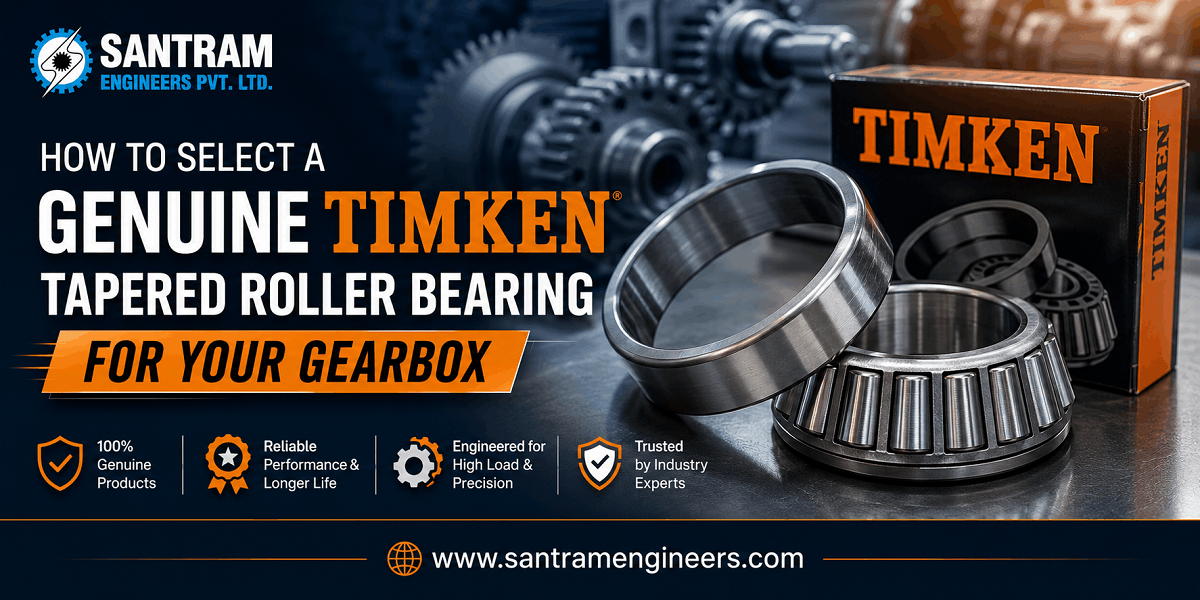
Timken tapered roller bearings ship as two separable parts. The cone is the inner ring assembly. The cup is the outer ring. They’re normally mounted in opposing pairs on a shaft, which is why ordering just one half of a matched set is one of the more common mistakes on a gearbox rebuild.
Reading the Cone and Cup Dimensions Before You Order
Metric Timken tapered roller bearings carry a numeric part number, such as 30208 or 32206. The digits encode the bore size, the series, and the contact angle family. Letters before or after that number flag specific features, like a flanged cup, a double-row configuration, or a matched-clearance assembly set at the factory. Confirm the bore, outer diameter and width against Timken’s published dimension tables before you order. Don’t rely only on the number printed on your old bearing’s box. Boxes get mixed up on a busy shop floor more often than the parts inside them.
Choosing Between a Single Row and a Double Row Tapered Roller Bearing
A single row tapered roller bearing handles combined radial and axial load in one direction. It’s normally installed in a pair, facing each other, so the assembly resists thrust from both sides. A double row tapered roller bearing packages that opposing-pair arrangement into one unit. This saves axial space inside the housing, but costs more per bearing. For most standard helical or worm gearbox rebuilds, a matched pair of single row bearings is the more common, cost-effective choice. Double row assemblies earn their premium mainly on compact gearboxes, where housing length is genuinely constrained. See the full breakdown of single row, double row, and flanged cup tapered roller bearing configurations we stock for exact bore ranges and application fit.
Cross-Referencing an Old Bearing When the Paperwork Is Gone
On older machinery, the original bearing datasheet is often long gone by the time a replacement is needed. Measure the bore, outer diameter and width of the failed bearing directly. If the bearing is too damaged to measure, take the shaft and housing dimensions instead. A dealer who genuinely stocks authentic Timken stock can cross-reference those numbers against the current metric or imperial series. They can confirm the exact equivalent part number before shipping. That’s worth insisting on, rather than ordering from memory of an old brand name.
Is the Timken Bearing You’re About to Buy Actually Genuine?
Counterfeit bearings are a bigger problem than most buyers assume. The World Bearing Association, whose members include Timken, SKF, NSK, and NTN, estimates that roughly 2.5% of the global bearings market is counterfeit, a figure that runs into hundreds of millions of dollars a year in warranty claims, unplanned downtime, and equipment damage. Premium brands like Timken, given their reputation, are a frequent target.
Timken’s own guidance is direct: buy only from authorised distributors. If you’re ever unsure, contact Timken’s local office for a list of who actually qualifies. A few checks are worth running yourself before a new bearing goes into the housing.
Check the Marking, Not Just the Logo
Genuine Timken bearings use laser etching for their part numbers and branding. The mark is crisp. It doesn’t fade when rubbed, and it won’t scratch off with a fingernail. Counterfeit parts often use acid etching or stamped printing instead. It can look close from a distance, but feels rough or smears under light abrasion.
Scan Before You Install
Timken participates in the World Bearing Association’s Bearing Authenticator app. Scan the QR code on the packaging to get an authenticity response. It isn’t foolproof on its own, since some counterfeiters copy valid codes from genuine boxes. But a failed scan is an immediate red flag. A passed scan, combined with a clean physical inspection, gives real confidence.
Buy From a Dealer Who Can Prove Authorisation
The single most reliable check happens before the bearing even ships. Buy from a dealer who can show current, verifiable Timken authorisation for your region. Don’t buy from one who simply lists Timken part numbers on a catalogue page.
Genuine Timken Sourcing in Gujarat and Rajasthan: What Actually Changes
Timken isn’t a distant import brand for buyers in Gujarat. The company inaugurated an expanded bearing manufacturing facility in Bharuch, Gujarat, in April 2025, adding capacity for spherical and cylindrical roller bearings alongside its existing tapered roller bearing production at the same site. Add the Jamshedpur plant, and Timken now supports the Indian market through a genuinely regional manufacturing and distributor network, not just an import pipeline. That local footprint is part of why Gujarat and Rajasthan-based plants sourcing genuine bearings through an authorised Timken dealer for Gujarat and Rajasthan typically see shorter lead times. Buyers routing orders through importers or online marketplaces of uncertain origin usually wait longer.
The table below breaks down what actually changes between the two sourcing routes for a gearbox bearing order.
| Factor | Authorised Local Dealer (Gujarat & Rajasthan) | Importer or Unauthorised Reseller |
|---|---|---|
| Authenticity risk | Verifiable distributor credentials, traceable stock | Higher risk of counterfeit or refurbished parts |
| Typical lead time | Faster, stock held regionally | Longer, subject to customs and shipping delays |
| Cross-reference support | Dealer can match cone and cup spec against catalogue | Often limited technical support |
| Warranty and after-sales | Backed by dealer and Timken India | Frequently unclear or unenforceable |
This doesn’t mean every import route is a bad idea. Large OEMs running standardised gearbox lines sometimes have direct Timken supply contracts that make sense at volume. For most plant-level replacement and MRO purchases, though, a regional authorised dealer removes both the dimension-matching guesswork and the authenticity risk in a single step.
Selecting the right Timken bearing for your gearbox is really two decisions stacked on top of each other. One is the engineering call: tapered versus spherical, single row versus double row. Get that right before you ever look at a part number. The other half is matching the exact cone and cup dimensions and confirming the part is genuine. That’s where most avoidable failures actually start.
Treat both halves as equally important. A perfectly specified tapered roller bearing that turns out to be counterfeit will fail just as fast as the wrong bearing type installed correctly. The safest route for a gearbox rebuild in Gujarat or Rajasthan is a dealer who can verify both: the correct bearing specification for your load, and proof that what ships is the genuine part Timken actually built.
Frequently Asked Questions
What is the difference between a Timken cone and a cup?
The cone is the inner ring assembly that mounts on the shaft. The cup is the outer ring that seats in the housing. Timken tapered roller bearings are sold as separable cone and cup sets, normally supplied and mounted in opposing pairs so the assembly can carry thrust from both directions.
Can I use a single row tapered roller bearing instead of a double row?
Yes, in most standard gearbox rebuilds. A matched pair of single row tapered roller bearings, mounted facing each other, gives the same combined radial-axial load capacity as a double row unit in most applications, usually at a lower cost. Double row bearings mainly earn their place where axial housing space is tightly constrained.
How can I tell if a Timken bearing is genuine before I install it?
Check that the part markings are laser-etched, not stamped or acid-etched. Confirm they don’t smear or scratch off. Where available, scan the packaging QR code through the WBA Bearing Authenticator app. The most reliable check, though, is buying from a dealer who can show current Timken distributor authorisation for your region.
Does Timken manufacture bearings in India?
Yes. Timken operates a manufacturing facility in Jamshedpur and expanded its Bharuch, Gujarat plant in April 2025 to add spherical and cylindrical roller bearing capacity. It supports Indian industrial buyers through a regional distributor network, not direct import alone.
What should I do if I don’t have the original spec sheet for a failed gearbox bearing?
Measure the bore, outer diameter and width of the failed bearing. If it’s too damaged to measure, use the housing and shaft dimensions instead. An authorised Timken dealer can cross-reference those numbers against the current metric or imperial series to confirm the correct replacement part number.
Need Help Getting the Exact Timken Bearing for Your Gearbox?
Matching a gearbox to the correct Timken tapered roller bearing, and making sure the part that arrives is genuine, is exactly the kind of detail Santram Engineers handles for plants across Gujarat and Rajasthan every week. Planning a gearbox rebuild, or replacing a failed bearing? Reach out to Santram Engineers and Contact Us. Our team will verify the exact fit and confirm authorised Timken sourcing before anything ships.